
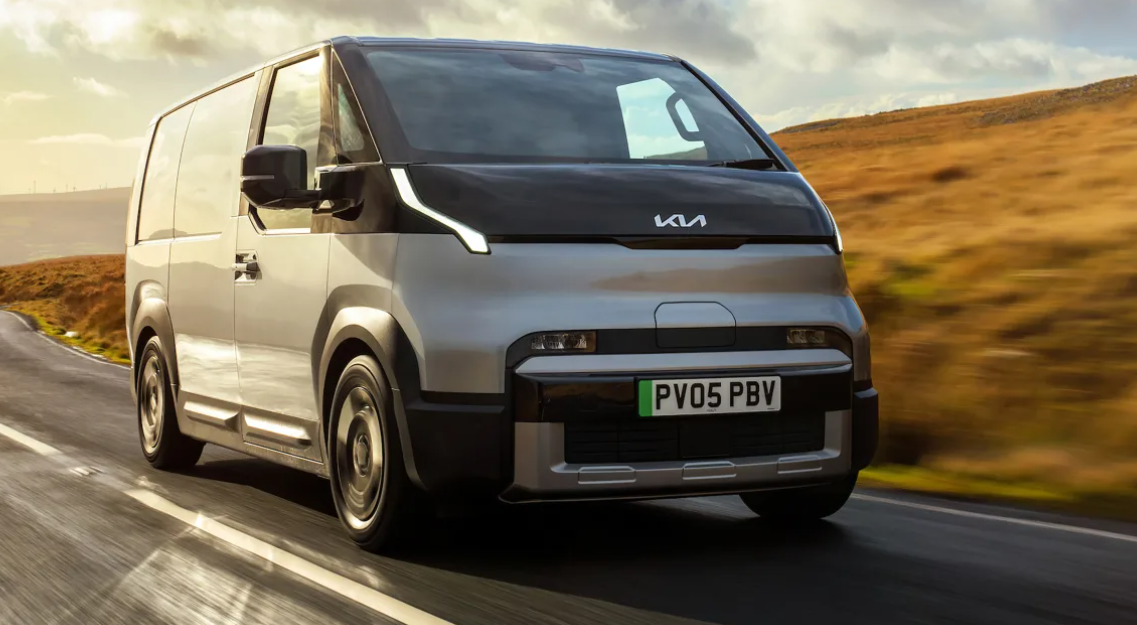
Our opinion on the Kia PV5 Cargo
It’s taken a very long time for Kia to enter the UK’s van market, but the Korean brand has clearly made the most of its electric car-building know-how to create a compelling first effort. The PV5 Cargo is distinctively designed and pleasingly car-like to drive for the most part, and a number of the crucial commercial fundamentals are present. While some shortcomings prevent it from sitting at the top of the class, this EV is still capable of carrying a good amount of cargo without demolishing the battery’s range. It’s also adorned with a generous amount of kit and is very easy to load.
It also appears that Kia’s top brass are fully aware of the challenge they face in prying buyers away from the usual van brands, such as Ford and VW. The PV5 Cargo claims up to 258 miles of range on the WLTP combined cycle, which is already competitive, but Kia’s highly appealing seven-year/100,000-mile warranty also applies. What’s more, the PV5 Cargo starts from under £30,000, which is thousands less than several rivals, including some diesel vans. The £5,000 Plug-in van grant does help here, though.
About the Kia PV5 Cargo
The medium-sized electric van market is filled with well established names such as the Ford e-Transit Custom, Volkswagen ID. Buzz Cargo and Vauxhall Vivaro Electric, as well as newcomers like the Farizon SV and Maxus eDeliver 7. This pattern means the Kia PV5 Cargo is a bit of an oddity; it’s a newcomer, but it comes from a brand that’s very well established in the car world.
For now, the PV5 is available exclusively as a panel van, but Kia plans to bring in a number of variants including a crew and chassis cab model. There’s also the Kia PV5 Passenger (for which we have a dedicated in-depth review elsewhere), which is an MPV — just like the Ford Tourneo is based on the Transit.
In order to truly put the Kia PV5 Cargo to the test, we drove it through a number of villages and towns as well as A and B-roads throughout East Sussex. We also compared this electric van’s carrying capacity to its rivals’, and rated its real-world efficiency against the official claimed figures.
Much like its passenger-carrying counterpart, the Kia PV5 is exclusively available as an electric van, so the usual emissions-based charging and VED road tax savings can be enjoyed with every variant. Insurance will take its share of your finances, though, because the PV5 line-up sits in groups 32 to 33.
Adjustable regenerative braking is fitted as standard to all PV5s, and this will help to maintain battery charge as well as providing the convenience of one-pedal driving in its maximum setting.
The level of regen can be changed via steering wheel-mounted paddles, but we encountered an issue in our test van which only allowed us to move above level one once the battery had depleted below 85 per cent. Kia has assured us that this is just a technical glitch that will be resolved with an over-the-air update. To be fair to the PV5, teething troubles certainly aren’t unheard of in vehicles at the beginning of their life cycle, but it does mean the regen braking’s impact on charge is yet to be seen by our road testing team.
Electric range, battery life and charge time
There are two batteries to choose from in the PV5, and Kia believes the biggest-seller will be the largest ‘long-range’ 71.2kWh pack. This claims up to 258 miles on the WLTP combined cycle, which outshines the Ford E-Custom’s 204-mile range, but falls a bit short of the Volkswagen ID. Buzz Cargo’s 276 miles.