
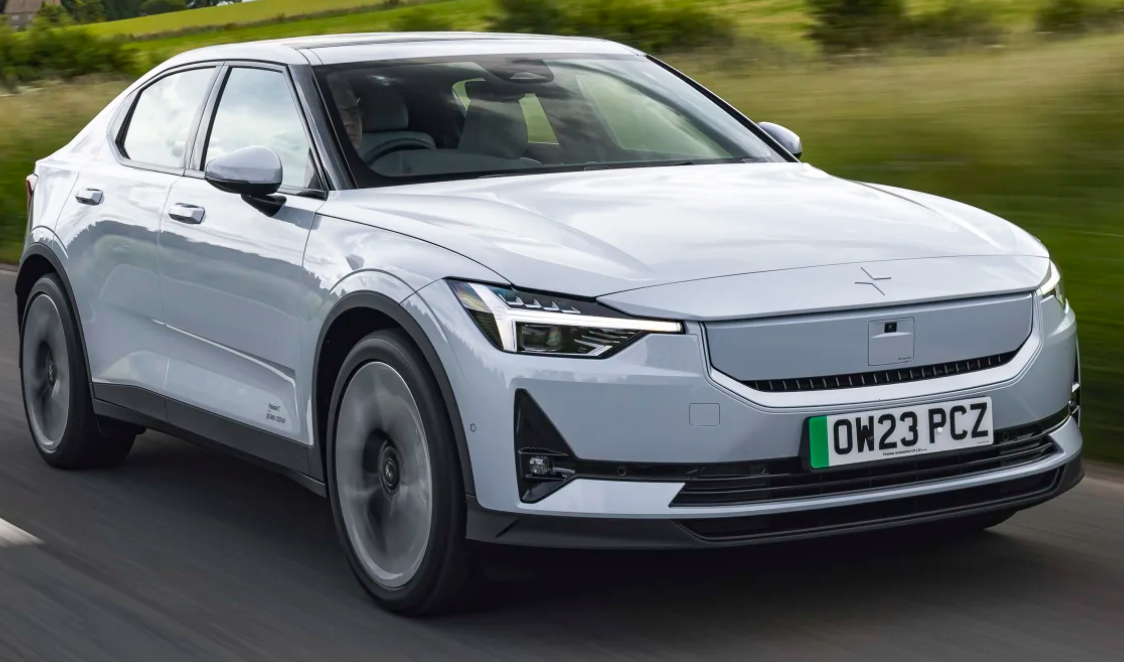
Our opinion on the Polestar 2
The Polestar 2 continues to deliver quality, style, great onboard tech, and reassuring levels of safety kit. The updated model gets more power and an official range of over 400 miles that few electric cars can even come close to matching (including some that cost twice as much).
For those seeking something different from a Tesla Model 3 in the compact, premium EV space, the Polestar 2 has most bases covered, and it’s competitively priced, too. Its main downside is that the ride is far too firm for most UK roads, and it doesn’t drive as sharply as the BMW i4 to make that a worthwhile compromise.
About the Polestar 2
It wasn’t that long ago that Polestar held the banner for Volvo’s motorsport activity (mainly in Swedish touring cars) before becoming the performance sub-brand for the Swedish marque’s quicker models. Now, under joint ownership of Volvo and Chinese giant Geely, Polestar is a maker of premium electric cars.
Polestar’s first foray into full vehicle production was in 2017 with the aptly named Polestar 1 – a low-volume, plug-in hybrid coupe. The fastback-styled Polestar 2 was the follow-up, an altogether more accessible car that the fledgling brand hoped would steal sales away from Tesla by offering a more stylish alternative to the hugely popular Tesla Model 3. Since the Polestar 2 launched in 2020, more players have entered the game, namely the excellent-to-drive BMW i4, retro-futuristic Hyundai Ioniq 6, and practical Volkswagen ID.7.
The Polestar 2 sits on Volvo’s Compact Modular Architecture (CMA) platform, which the Volvo XC40 SUV and Volvo C40 coupe-SUV also use. It has a saloon-like body but is actually a five-door hatchback with a slightly elevated ride height. This gives it a unique shape that’s not quite a crossover but still offers decent family practicality.
The Polestar 2 has undergone several updates over its lifetime, including a facelift in 2023. This included the addition of a ‘SmartZone’ grille panel, first seen on the Polestar 3, which houses various sensors, radar, cameras, and laser scanners for the autonomous safety systems. Other changes included switching the Single-Motor versions from front to rear-wheel drive, making the electric motors more powerful and efficient, and fitting larger batteries to Long-Range models.
There are no trim levels for the Polestar 2; instead, there are three additional packs that build on the already generous standard equipment list.
The Polestar 2 has been a persistent thorn in the Tesla Model 3’s side for a number of years, so we felt it was only fitting that we pit the two EVs against each other in our real-world twin test. Here, the 2 couldn’t quite beat back its big-selling nemesis. Our road testers were impressed with the Polestar’s battery range, performance and interior, but its firm ride quality and limited rear-seat space held it back.
To get a better taste of life with the Polestar 2, our former features editor, Chris Rosamond, spent six months with a Long Range Single Motor as part of our long-term test fleet. Chris had no qualms about taking on very long journeys thanks to this car’s immense battery range, but the aforementioned rear space issue meant his younger passengers drew the short straw.
Polestar 2 prices and latest deals
Pricing for the Polestar 2 starts at around £45,200 for the Standard Range Single Motor variant, which is slightly more than the equivalent Tesla Model 3, which starts at closer to £40,000. At the top end of the line-up sits the Long Range Dual Motor, which surpasses the £53,000 mark. You’ll then need to add another £5,000 if you want to add the Performance Pack on top of this.
Unfortunately, the Polestar 2 doesn’t qualify for the Government’s Electric Car Grant. However, you can still save money by building your perfect Polestar 2 via the Auto Express Buy a Car service. We also have new Polestar 2s in stock and ready to hit the road. You can sell your car with us, too.
Performance, 0-60mph acceleration and top speed
The Standard Range Single Motor Polestar 2 produces 268bhp and 490Nm of torque; enough to go from 0-62mph in 6.2 seconds and hit a top speed of 127mph (the same as all Polestar 2s). The Long Range Single Motor only gets a slight power bump up to 295bhp, though torque stays the same. It takes 5.9 seconds to complete the same benchmark sprint.