Our opinion on the Renault Master
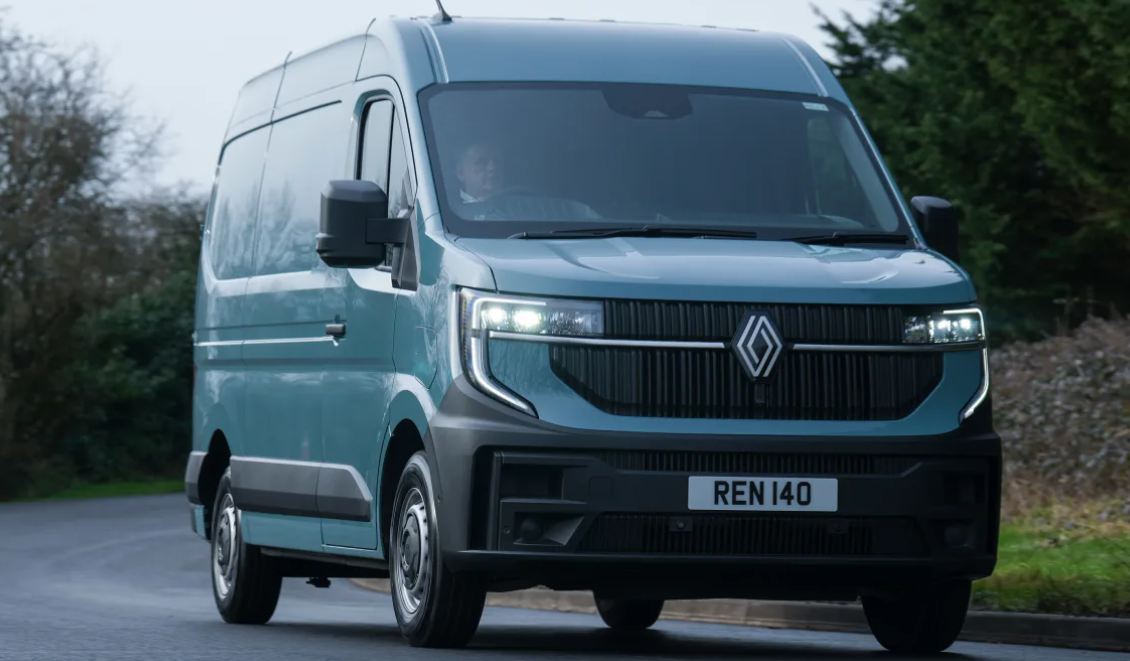
The latest Renault Master is a far more distinctive machine than any van to wear this moniker before it. Thankfully, the French brand’s engineers haven’t got too carried away with its aesthetics, though, because this large panel van also offers plenty of practicality.
On the move, a lofty driving position provides a clear view of the road ahead, while the weighting of its controls, noise levels, and ride comfort all help to make the Master an intuitive and comfortable van to drive. It certainly feels its size at times, though.
About the Renault Master
For the fourth-generation Renault Master, the firm has redesigned its large van from the ground up. It looks like an evolution of the last model with a sharper front end, but the dimensions have been changed to maximise cargo space, as well as boost efficiency for both the diesel and electric versions. Renault has seen fit to redesign the Master so that it can maintain sales in the face of strong competition in the market, including the Ford Transit and Mercedes Sprinter.
The obvious change to the Mk4 Renault Master is a sharper look up front, with a more upright grille, a prominent Renault badge on the nose and the brand’s signature C-shaped daytime running lights. But what you can’t see is the enhanced aerodynamics of the front end. The bluff front merges into a more upright windscreen, which helps to smooth airflow, while vents cut into either side of the bumper help to reduce drag. At the rear, the roof droops slightly at the trailing edge to help improve aerodynamics, but this doesn’t come at the expense of cargo capacity.
In the UK there are three lengths and two heights to choose from, plus chassis cab, tipper and conversion options available. Renault claims a total of 40 different configurations are on offer. Power comes from a choice of three diesel engines or a fully electric ‘E-Tech’ set-up.
Prices kick off at around £34,000 (exc. VAT) for the entry-level diesel Master in L2H2 configuration. The electric Master E-Tech is pricier, starting from around £42,500 (exc. VAT), but this drops thanks to the Government’s plug-in van grant, and means that while the Master has a longer range than large electric van rivals, it costs a few thousand pounds less than its Ford and Mercedes competitors.
Thanks to its redesigned body, the Renault Master has 20 per cent less drag than the old model, and Renault claims that it’s the most aerodynamically efficient van in its class. In the real world, that means improved fuel economy and lower emissions, while the Master E-Tech offers a longer range.
The diesels use the latest Blue dCi 2.0-litre four-cylinder engine with three power outputs. The base 130 engine can achieve up to 33.2mpg on the combined cycle, a figure that’s matched by the most powerful 170 engine. The middle-tier 150 engine is slightly better, achieving up to 34mpg. These figures are for Masters equipped with the manual gearbox – we expect fuel economy to drop marginally if the nine-speed automatic is fitted.
Emissions figures are impressive for the class, with a 39g/km reduction when compared with the outgoing Master. Figures range from 196g/km to 236g/km for all engines, with the exact figure depending on specification. There’s an ‘Eco’ mode for maximising fuel economy, but this simply reduces engine power by 30 per cent, and if you’re carrying a heavy payload, then you’re likely to cancel out any savings it might deliver by using the throttle harder, especially with the dCi 130 motor.
Electric range, battery life and charge time
The electric Master E-Tech is fitted with an 87kWh battery (up from 57kWh in the older version), which provides up to 285 miles of range. This is a smaller pack than some rivals offer, but the aerodynamically efficient bodywork means that range compares favourably, beating the latest E-Transit’s 249-mile maximum, the Citroen e-Relay’s 263-mile range, and the Mercedes eSprinter’s 272-mile range.
During our first test drive of the Master E-Tech, we saw the battery lose 21 per cent of charge over the course of 52 miles with a 400kg payload, suggesting a laden real-world range close to 250 miles. We drove across a mixture of high-speed and urban roads, in 20-degree celsius temperatures with the air-conditioning on. You can expect a shorter range in cold conditions. During another test in an unladen Master E-Tech, the trip computer recorded efficiency of 2.4 miles per kWh, which isn’t bad for such a large and heavy electric van.